Last modified: 2015-08-27
Abstract
Performative and adaptive architecture is very popular nowadays. Especially, environmental problems such as climate changing and air pollution is increasing by the non-technologic buildings. So, designers are interested on the adaptive building to stop this environmental problems as soon as it is possible by some technological methods as performative and adaptive architecture. In this article, performance based adaptive building envelop design criteria and methods will be explained with a building envelope (model suggestion), that has adaptation ability to sun.
Introduction
Within this article, it is evaluated that the theoretical works and application data. The performative, adaptive and pneumatic architecture which are explained in theoretical part of the article, are examined in terms of the place in architectural medium, design strategies and project examples. At the end of these examinations, some deductions are made. In the application part of the article, it is examined how the adaptive envelope reacts in the different time zones and different places and seasons. Also the algorithm is applied on different geometries to analyzed the forms which emerged according to the sun. These output are collected and evaluated to understand how the algorithm works. Outcome is affected differently according to the parameters. In terms of model proposal, the computer programs which related to the computational design are used.For the method of the proposal, nature inspired approach is used. The opening and closing of the stomas which are the pores of the plants are analyzed. These systematical pressure changes which are observed in the plants provide to use a different analogy technic for the application of the model. Thanks to the nature inspired design approaches, the optimization of the building envelope according to the sun is ensured and the algorithms which are led to the changes in building morphology are created.
1. Performative Architecture
Performance based adaptive buildings have become much more important in case of the changeable climate parameters. Performance based adaptive building envelopes, which can change according to the environmental factors, enhance the living comfort of the users, ensure the sustainability, reduce the operation costs and extend the life of the building thanks to integration the other disciplines with the architecture. The architectural design has different methods. Performance based adaptive architecture is one of these methods. Because the architecture issues are related to lots of variables, it has become necessary to examine these issues with the other disciplines like engineering, natural and social sciences. In this article, it has been evaluated severally in regarding to performance based adaptive architecture and these evaluations are shown via the example analyses. The inputs of the performance based design are examined and the effects of these inputs upon the adaptive building envelope are explained by evaluating the data (Oxman, 2008).The important part of the article is derived from the recently developing issues according to the changes in architectural approaches like the performative, adaptive and pneumatic architecture. “Form follows performance” is a new tag for todays architectural style (Hensel, Menges, 2008). In this article, it is explained that the effects of computational design tools upon the design of the adaptive systems by authors. In the design process of the project which is proposed, it is examined that the effects of the parametric based design tools upon the performance based adaptive and pneumatic systems. It is clarified that the software which are used in constitution of the different systems, morphologies and geometries, the methods and the researches in regards to algorithms providing the control of the performance based adaptive and pneumatic morphologies within the project.
2. Adaptive Architecture
Adaptive buildings and facades are emerged at the beginning of the 1980’s (Wiggington,2002). Adaptive buildings can process the conditions inside and outside of the envelope and change its forms according to effect or turn some passive climatic systems on. For adaptive architecture, environment must be harmonious with architecture and other natural and artificial elements must be harmonious with building envelope (Ghamari, Asefi,2010).Adaptive architecture provides the user to live under the comfortable and ideal conditions in the building by forming the architecture with environmental factors. Addition to this, adaptive architecture is important regarding the protecting the environment and sustainability. In the world which the conditions change constantly, the environmental factors play an important role. It is necessary to design adaptive buildings in which the climate changes occur permanently. Adaptive architecture as discussed in this research proposes a new strategy for performative architecture defined as a multi-layered system that communicates with environment, in this case humans, through both software and hardware and has the ability to change its rules during its interaction with the environment.Adaptive building have many advantages when we compare to traditional buildings. This advantages that is during life-cycle are more comfort for building users, more stable buildings, less management expenses and sustainability.Adaptive buildings also have some potentials for future and nowadays. These potentials are developed “decision support mechanisms”, material technology (nano- technology etc.), computer aided design and computer aided manufacturing tools.In this article, definition of adaptive buildings, advantages and potentials of adaptive buildings and design process of performance based adaptive building will be explained.
3. A Model for Designing Performance Based Adaptive Building Envelope
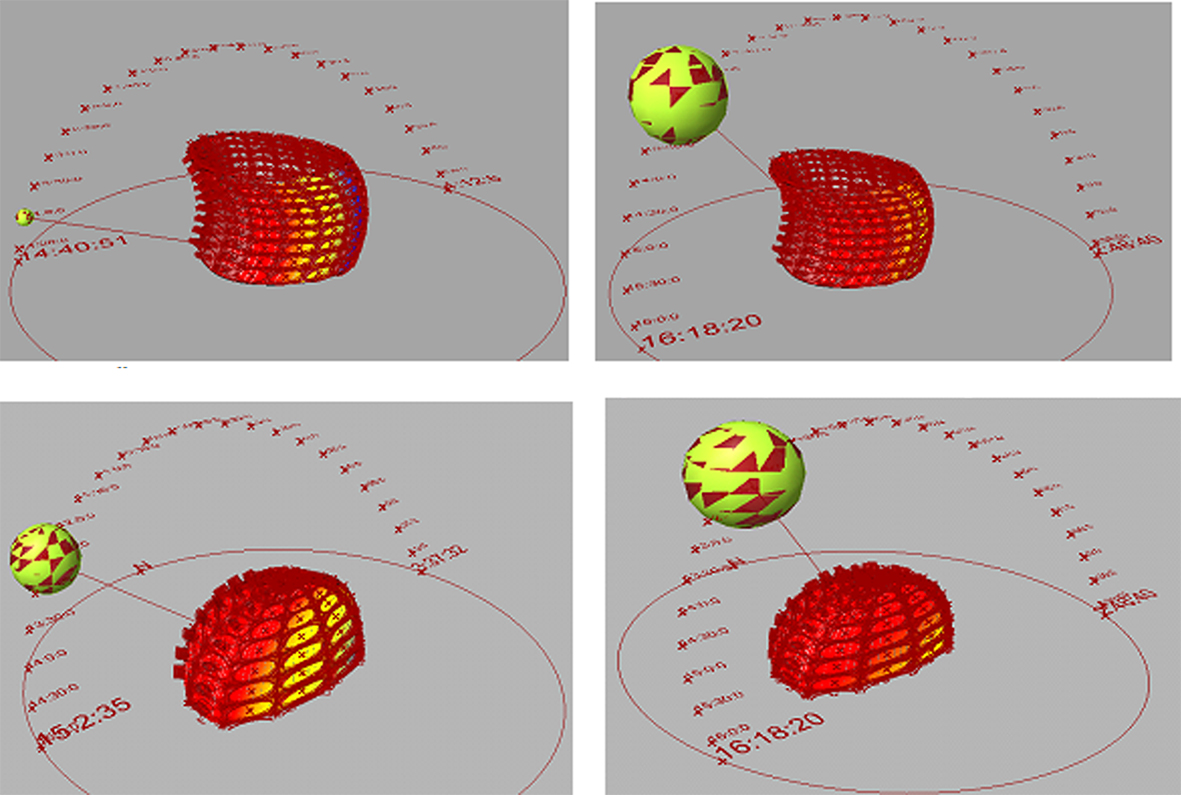
Sun is the most important parameter for environment and climate, especially for a model that is performance based and adaptive. In this chapter, design process of a model that is react to the sun and its data in a simulation with different software will be explained.Performance based adaptive building envelope is designed with the “Rhinoceros” and “VB.net scripts” and by the data of suns position changings as the seasons and times during the day. Solar radiation is calculated with a parametric software script in VB.net and building envelope is changed according to sun and its data such as solar radiation, angle, latitude, longitude and other parameters. In this model design, there is a grid systems that include some modules uniquely designed and react to environment by its own data. Some parameters for this model are simulated first as a solar radiation and then angle and the other parameters and then it optimize the all modules. After all modules are calculated oriented to sun, porosity of the modules can be change by the data and this envelope control system by an algorithm.In this article theoretical information and a model application will be explained and details of the model will be shown with graphics and tables as a data, model and simulations.
Keywords
References
Ghamari H. ve Asefi H. (2010). Toward Sustainability by the Application of Intelligence Building Systems. The Second International Conference on Sustainable Architecture and Urban Development, Amman, Jordan.
Hensel, M. and Menges, A. (2008). 'Gebaute Umwelt und Heterogener (Lebens-)Raum – Das Konzept der Morpho-Ökologie', Form Follows Performance – Zur Wechselwirkung von Material, Struktur, Umwelt, Arch+ 188: 26-30.
Oxman R. (2008) "Performance based Design: Current Practices and Research" Issues IJAC International Journal of Architectural Computing Vol. 6 Issue 1 pp. 1-17. (Expanded and modified version of prior paper - emphasizing current practices).
Wigginton M. (2002). Intelligent Skins. Butterworth-Heinemann LinacreHouse. Jordan Hill. Oxford.